Tesla · Architecture
Module architecture & variant reduction
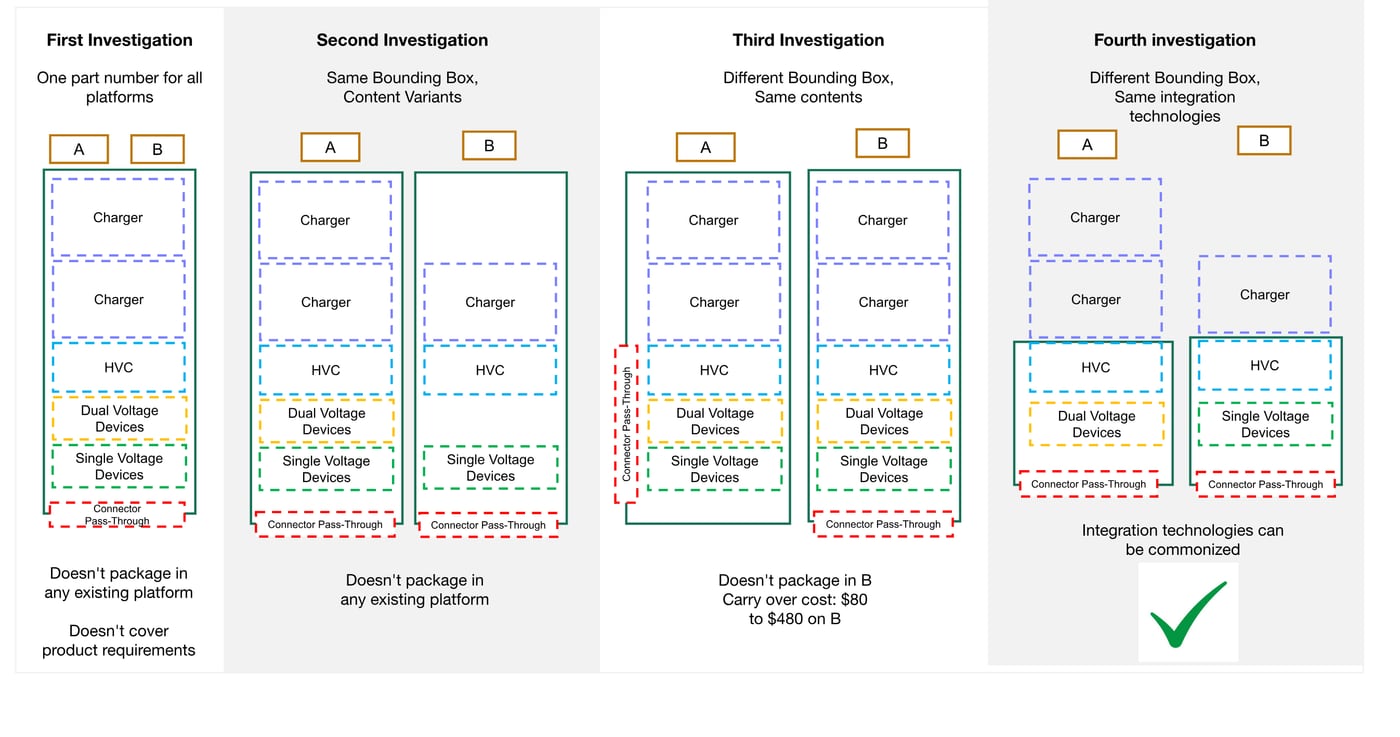
The goal was one part number across platforms. Four investigations tested how far commonisation could actually go.
The four investigations
A single part for everything; a shared bounding box with content variants; different bounding boxes with the same contents; and finally different bounding boxes sharing integration technologies. The first three failed on packaging or requirements coverage. The fourth showed that even when the box must change, the integration technologies commonise — which is where the durable savings live.
Scoping the opportunities
Each change was assessed by cost, technical risk and schedule rather than picked by instinct. Two of the largest savings carried medium risk; the very-high-risk items were worth far less, which is exactly the sort of thing that stays invisible until you tabulate it.
| Design change | Cost | Risk |
|---|---|---|
| Eliminate flex busbars | −$28 | Med |
| Integrate planar magnetics | −$20 | Med |
| Harness reduction — solder devices to HVC PCB | −$9 | Very high |
| Consolidate insulators | −$5 | Med |
| Reduce module extents | −$2 | Very high |
| Weld busbars to devices | Neutral | High |
| Charger outside penthouse | Neutral / negative | High |